Showing posts with label St Palais. Show all posts

Sunday, 8 September 2019

Toulouse to Vaux - un road trip estival


The journey began with a flight from Bristol to Toulouse, capital of France’s southern Occitanie region, the fourth largest city in France - after Paris, Marseille and Lyon, with the Garonne River and Canal Midi running through it. Also known as La Ville Rose (‘The Pink City’) due to the terra-cotta bricks used in many of its buildings.


We were met by close friends Dave and Sue, now French citizens, who arranged both the trip and our transport.


Toulouse has a bloody past slaughtering thousands as witches, wiping out tens of thousands of Cathars, inadvertently inviting the plague into the city and establishing a substantial training centre for the Inquisition.

Today it is a bright vibrant city containing many architectural delights, a large student population, many green spaces and a lively night life.


is she real or is she not?


Had an interesting walking tour of the City led by Harry, a Glaswegian of Canadian extraction now residing in Toulouse and a mine of information and historical facts.

The tour included the Cathedral – two substantial churches conjoined 


 and the training ground for the Inquisition.


Followed by a boat trip down the Canal


Heading for Cordes we stopped off for some traditional wine tasting at Domaine Sarrabelle.


Cordes sur Ciel

Cordes-sur-Ciel is a commune in the Tarn department in southern France. A fortified town was built in 1222 by Raimon VII, the Count of Toulouse, who, though not a Cathar, tolerated what other Catholics considered heresy. Since the late 20th century, the village has become a popular tourist destination due to it’s narrow streets and unrivalled views over the surrounding countryside.


High on a hill our luxurious apartment overlooked the valley below. An early morning mist made the scene appear on par with Brigadoon.


Our excellent host provided an equally excellent breakfast feast.


Off on the road again there were brief stops at -

Chateaux Bruniquel 

The Chateaux hang on a cliff top, overlooking a gorge, whose access is quite steep. According to legend, the Merovingian Queen Brunehaut or Brunhilda built the first castle, "the old castle" or "castel Biel" in the 6th century on the site of a Roman castrum. The "new castle" dominates the confluence of the Aveyron and Vere from a height of 80m. It was built between 1485 and 1510 and was remodelled during the baroque period.


St Antonin Noble Val

Founded in the 8th century around a former Benedictine abbey  the mediaeval town of Saint-Antonin-Noble-Val nestles at the confluence of the Aveyron and Bonnette rivers. At the heart of the old town, near the covered market, stands the former town hall, or Maison Romane ("Romanesque House"), dates from 1125 and is one of the oldest civil monuments in France.


The end of this days journey was Perigueux, a town in the Dordogne region of south western France. It’s known for the landmark Saint-Front Cathedral, with domes and turrets.

The town has been in existence since neolithic times, and later became an important Roman centre. The town suffered a great deal in the Middle Ages through the Hundred Years War and other conflicts in the region, then had a 'rebirth' - and much construction in the town dates from this time - in the 16th century. From the 18th century onwards, Perigueux continues to be an important centre for the region.

They were clearly expecting us as the streets were festooned with bunting :)


Couldn’t resist a circular tour on the mini land train.


From Roman times, you can see the Vesone Tower and the remains of the amphitheatre.


After a short break in Chateauneuf sur Charente


we began the return journey to Dave and Sue’s at Vaux sur Mer.


Delights this year included

Beach Days


A trip through the forest and along the causeway to the Ile Madame


IIe Madame, near La Rochelle, is and is not an island. It all depends on the tide. Sitting in the centre of the Charente Estuary, low tide exposes a natural causeway which can be crossed by car, foot, bicycle, horse, etc. But at high tide, the causeway disappears and Ile Madame becomes a true island. The island has an area of four square miles and is unpopulated. Hundreds of Catholic priests were held prisoner on the island during anti-clerical persecution in 1794.The islands position was of strategic importance.

The waters around the island are home to a diverse population of fish, shellfish, algae, and other marine life. The salt marshes and higher grounds also provide space for a wide variety of birds and plants. The island’s softer water also turns out to be perfect for raising oysters. All around the island are oyster beds. 


Sunsets over St Palais


Music in the ‘Les Jeudis Musicaux’ season, where the churches of the AgglomĂ©ration Royan Atlantique take turns to provide regular summer evening concerts. This session string jazz par excellence.


... and so back to the UK via Bordeaux. Au Revoir for another year -


Play us out Dave


Sorry we have to rush but ... we've no time Toulouse (sorry :)

Friday, 8 September 2017

Nouvelle-Aquitaine


Just back from visiting great friends Dave n Sue at their magic abode in Vaux sur mer. Celebrated with them as they transitioned from ex-pats to full French citizenship – many congrats.


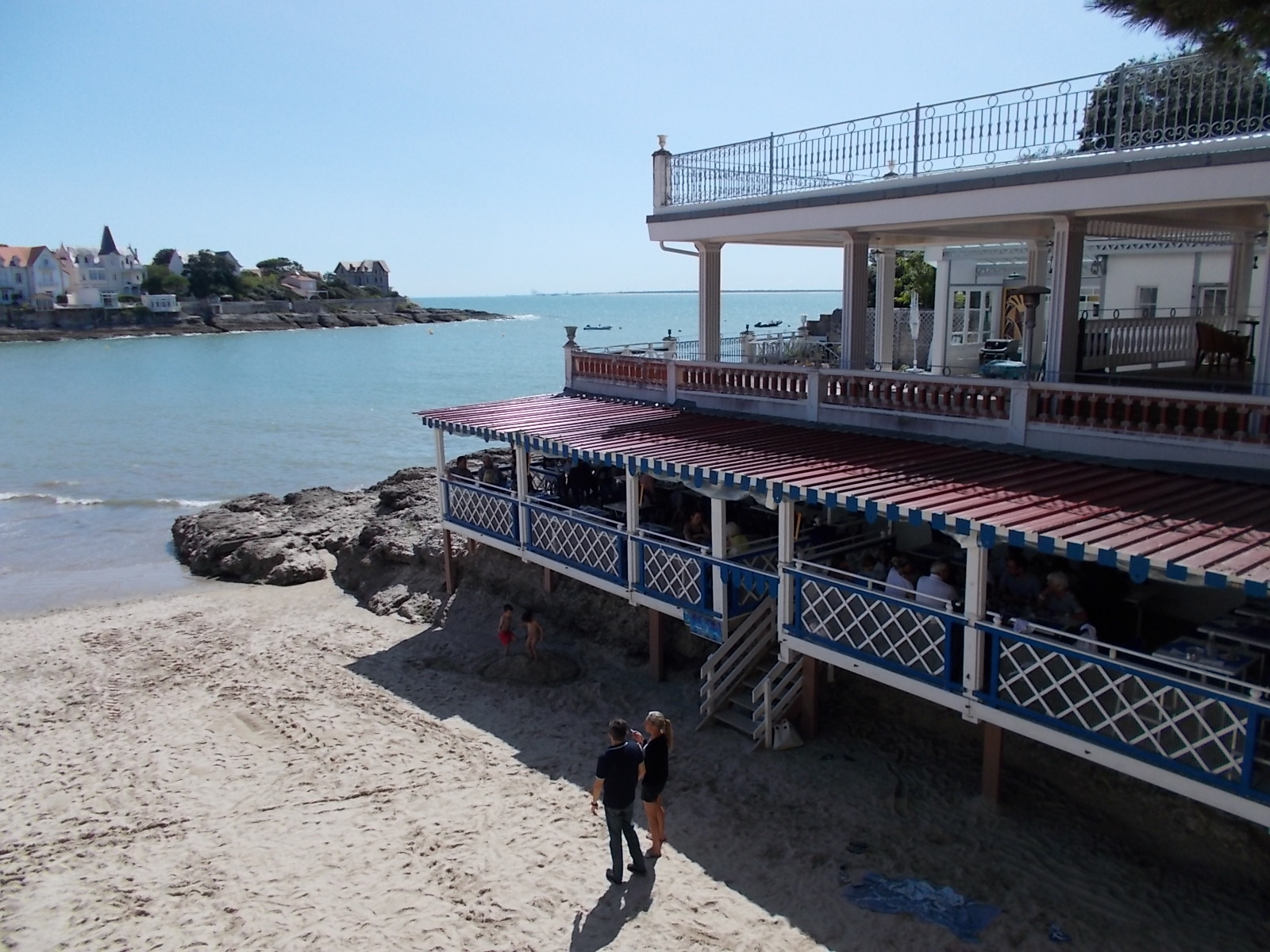
Nestling on the Atlantic coast close to Royan, the local beach of Nauzan is a sheltered crescent of beach ideal for families – also has a Tiralo chair for people with reduced mobility to enter the water - with bars & restaurants and a lifeguard and first aid station in the summer period in the immediate vicinity. You can follow your beach day with a relaxing drink at La Maison Blanche.


Follow the picturesque headland Custom path round to Saint Palais sur Mer. A traditional seaside resort situated between the smaller beach of Nauzan and the larger textile/naturist shared beach at plage naturiste les combots. Here you can taste the delights at Nausicaa or Chez Lolo.


The area gets very busy during August as hoards of Parisians head to this part of the coast for their annual holiday.

The headland walk up from St Palais takes in the long bay with its legendary rocks. This walk offers a panorama of the "carrelets" - traditional fishing huts on stilts – a famous example of a blow hole and crowned by the Terre-Nègre Lighthouse.


There are stunning views of sunsets to be had from the headland.


There is much to see and do in the surrounding area. Special mention of ‘Les Jeudis Musicaux’ where the churches of the AgglomĂ©ration Royan Atlantique take turns to provide regular summer evening concerts where international artists and talented musicians give recitals. The programming blends beautifully the architecture of buildings with the music. 


Also the stunning seafront of Ryon and its marina and its ‘Cotton Club jazz venue


The surrounding area contains many Chateaux with stunning features – in season you drive through miles of sunflowers, vines and corn fields. This year we visited the beautiful Chateau de La Roche Courbon


and the ancient Citadel at Blaye. The Citadel encloses a one meter long small town and has stunning views of the Gironde from the battlements.


It also houses superb eateries.


All too soon it’s time to say goodbye again